
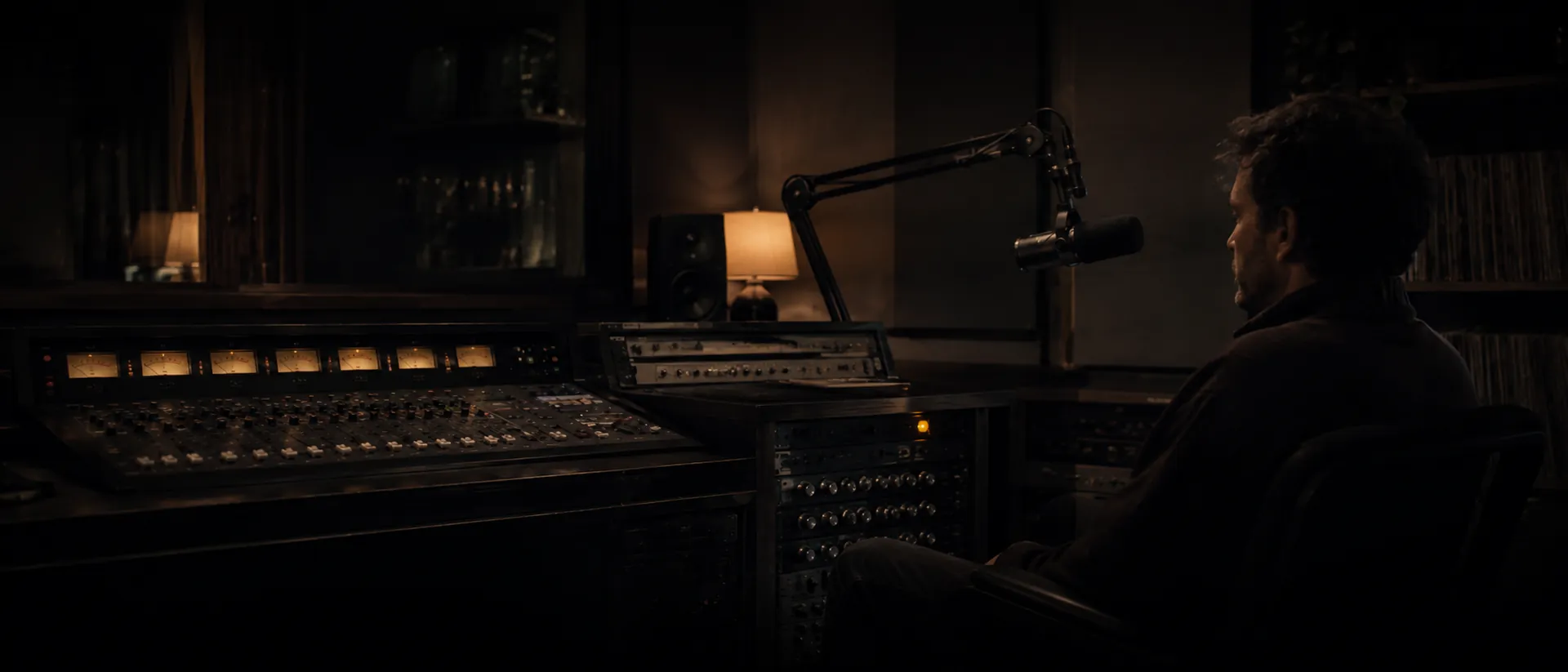
The night the transmitter froze and nobody noticed
For eleven minutes on Tuesday we were broadcasting nothing but the sound of the room. Two people wrote in — one to say it was the best set of the week, one to ask which label it was on.
It starts with a relay in the rack that has been clicking since spring. Nobody wrote it down, because it clicked and then it worked, and a thing that works is easy to leave alone for another week. On Tuesday at 01:58 it clicked and did not come back.
What went out was not silence in the technical sense. The desk kept feeding the transmitter, the transmitter kept modulating, and what it modulated was the room: the fridge in the corner, the tram on Prinsengracht, and Ines turning a page. Anyone tuned to 94.8 heard eleven minutes of a room in Amsterdam at two in the morning.
The first message came in at 02:04, from a listener in Utrecht who wanted the label. The second, at 02:07, said it was the best thing we had played all week and asked whether we would do it again on purpose. Neither of them thought anything was broken, which is the part we keep coming back to.
We only noticed because the archive recorder writes a level file alongside every hour, and the level file for that hour was flat. By then the relay had warmed up and closed itself, the next record was playing, and the night carried on.
Silence on a frequency you pay for by the hour is expensive. Silence that four hundred people sat through is something else entirely.
On Wednesday morning we pulled the rack apart on the studio floor. The relay is from 2011 and was never meant to sit in a warm cupboard for nine years; the contacts had pitted enough that a cold start could not always bridge them. It cost eleven euro to replace, which is roughly what one hour and a half of air costs us.
The larger fix is procedural, not electrical. There was no alarm on the outgoing signal — we were monitoring that the desk was sending, not that anything was coming back. Since Thursday a small box listens to our own FM output and messages the phone on the desk if the level drops for more than twenty seconds.
We are keeping the recording. It is in the archive, unlisted, filed as ELEVEN MINUTES OF NOTHING, and two of the hosts have already asked to play parts of it. That was not the plan, but it is the sort of thing that happens when the equipment writes the programme for you.
Relay replaced; the spare now lives in the drawer with a date written on the bag.
A signal alarm listens to our own FM output and pings the desk phone after twenty seconds of nothing.
Backup line is checked out loud at the start of every night shift, by name, like an aircraft checklist.
The rack cupboard door stays open after 22:00 — it runs eight degrees cooler that way.